
1. Define the requirements precisely
The first step is to record product dimensions, weight, protection needs, logistics, labelling, desired appearance and the planned production quantity. The customer's processes are equally important: will the carton be erected, filled and closed manually or automatically? What tolerances does the machine require?
2. Design the structure and produce samples
The requirements form the basis of a technical design. Board grade, grain direction, creases, closures, glue flaps and the layout on the printing sheet are considered. An unprinted or printed sample makes it possible to assess handling, fit and appearance before series production.
3. Prepare for reliable production
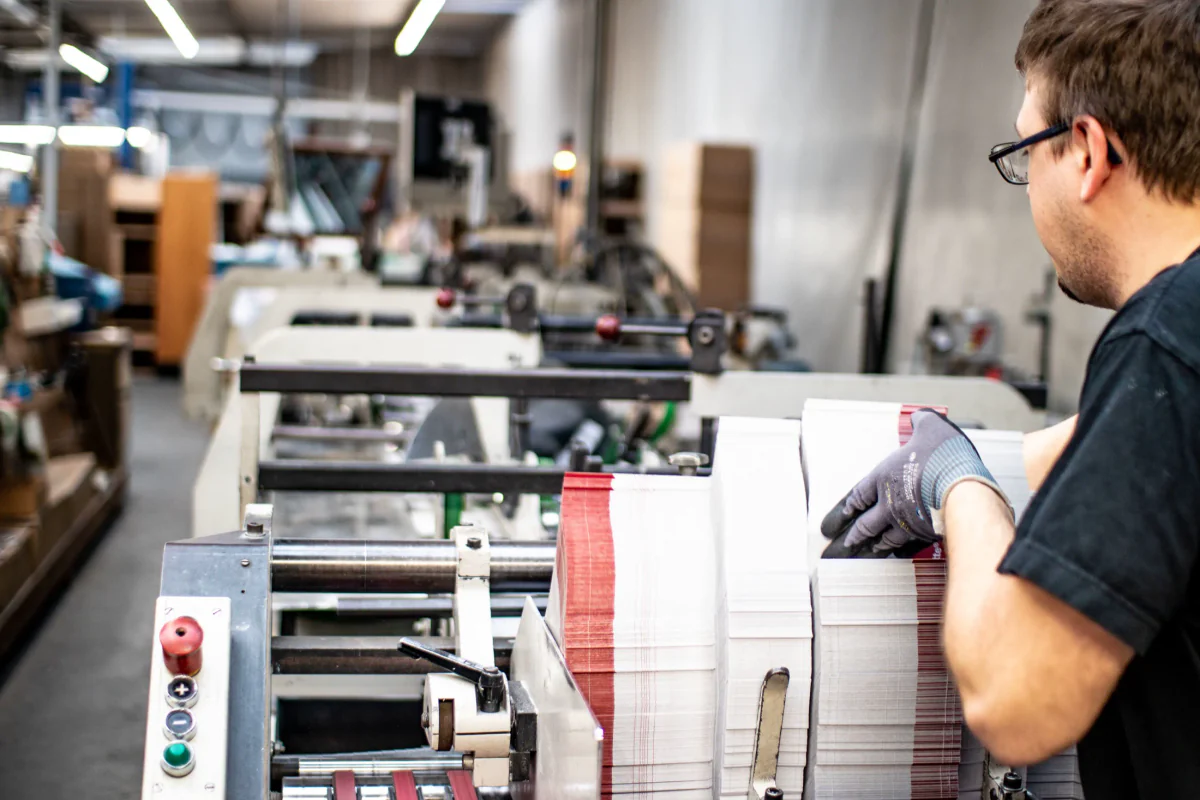
After approval, print data, tooling and process parameters are prepared. Offset printing, die cutting, embossing and folding-carton gluing are coordinated at the Windeck site. The aim is reproducible blanks, clean folds and dependable processing at the customer's premises.
HvC supports this process with dedicated contacts from enquiry through to series production. Early coordination reduces revision cycles and makes it easier to achieve a cost-effective solution.
What we need for a custom structure
The more precise the initial data, the more focused the start of development can be. Useful information includes product samples or 3D data, dimensions and weight, the desired packing sequence, protection requirements, annual quantities and batch sizes, and details of transport, storage and existing packaging machines.
Existing problems—such as damage, difficult handling or interruptions during erection—also belong in the brief. Drawings and other documents can be submitted securely using the enquiry form.
Assess samples against specific questions
A sample is most useful when it is clear in advance what needs to be checked. Product fit depends on the intended product and, where applicable, its primary packaging. Handling involves the packing sequence, opening, removal and closure. Looking at the external shape alone does not answer these questions.
Automated processes also involve feeding, erection and interaction with the customer’s line. Record any difficulties as specifically as possible and discuss which change should be assessed with the next sample. Final suitability is evaluated under actual conditions of use.
- Have the intended product and packing sequence available for sample assessment
- Associate the structural design and print data with clear version references
- Keep a traceable record of open points, changes and approvals
Plan manufacturing and the customer’s process together
Alongside structural design, variants, production quantity, delivery batches and the preferred date influence production planning. Discuss these details early and agree them for the specific order. A general development process does not establish a fixed delivery time.
HvC develops and manufactures the carton packaging. Filling, fulfilment and packing finished products belong to the customer’s process. Where required, special finishes such as hot-foil stamping or relief varnish are coordinated through specialist partners and considered in the technical planning.
Your application sets the requirements.
We would be happy to discuss which structure and material suit your product and process.
Enquire about packaging ↗